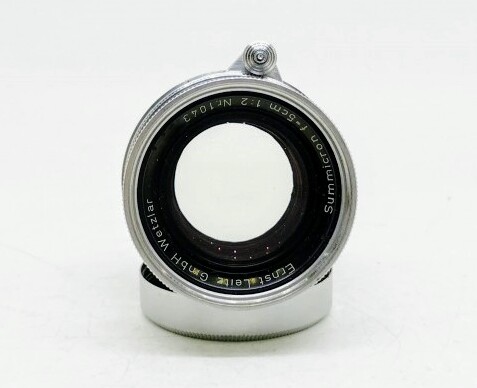
One of my key reason for selecting the Leica 50mm Summicron Collapsible radioactive len is to be the same as the old leica advertisement. This is how my Leica M3 look, similar to the old vintage leica M3 advertisements.
Monday, 5 March 2018
The Summicron 50mm Lens by Harold M. Merklinger as published in Shutterbug, June 1994.
The Leitz 50 mm f/2 Summicron
set a new standard for normal lenses
when it was first introduced about
1953. A few prototypes were actually
engraved Summitar*. This new lens
had two particular features which
distinguished it from its predecessors.
It was the first “high speed” lens that
equaled the performance of the 50/3.5
Elmar at any given f-stop. Thus the
35 mm photographer could choose a
single normal lens without sacrificing
either quality or speed. He could have
both. And second, the Summicron
was designed to have uniform image
quality across the format, even at the
larger apertures. Earlier lenses, and
the lenses of other manufacturers,
were designed for sharp, contrasty
results in the very center, but image
quality deteriorated towards the
edges.
The original 50 mm Summicron
was produced in a collapsible mount,
much like the Summitar and Summar
that preceded it, and like it’s sibling
50/3.5 Elmar. The higher speed
50/1.5 Summarit was always in a
rigid mount. In about 1956 a rigid
version of the 50/2 Summicron for
M-series cameras appeared with little
explanation. A special version of the
rigid lens, the Dual-Range
Summicron for the M-3, did feature
provisions for close focusing,
however. It was not ’till 1960 or so
that the rigid lens became available in
screw mount—just as production of
screw-mount Leicas was drawing to a
close. Any number of references will
tell us that the collapsible and rigid
versions of the Summicron are
optically identical. This information
is erroneous; these two versions of
the 50/2 Summicron are different
designs.
As the accompanying photograph
will show, the rigid version of the
lens is longer. The optics are set
farther from the film and the lens
mount than is the case for the
collapsible version. The front element
and the rear element are both set
farther forward. This does not mean
the focal length is different, however.
The two lenses are simply different
optical designs. Additional evidence
may be seen in the photograph. The
depth of field scales are identical, but
the mark for infra-red focusing moves
from the f/2 mark on the earlier lens,
to roughly half-way between the f/4
and the f/5.6 marks on the later lens.
In my view, the rigid Summicron
represents as great a milestone in lens
design as does the collapsible
Summicron. The collapsible
Summicron becomes somewhat
lack-luster at apertures larger than f/4.
The rigid Summicron, on the other
hand, is fully usable at it’s maximum
aperture. Images taken at f/2, even in
the close-up range, are stunning in
sharpness and contrast. The f/2
aperture finally became a true
working aperture, not a low light
emergency back-up. The rigid design
also re-established the Summicron as
the best normal lens available. Lenses
of f/2 and f/1.4 from the Japanese
competition noticeably surpassed the
collapsible Summicron in the center
of the image field—as for that matter
did the Summitar, though over a very
small angle only.
I still rely on the original rigid
Summicron whenever I seek the
ultimate in 50 mm lens performance.
This forty year old design is still
among the very best!
© Harold M. Merklinger,
Saturday, 3 March 2018
Vintage Leica M3 day 2 experience
This is my second day in using the Leica M3 ith 50mm len. Instetad of using my phone apps light meter, the newly integrated light meter has made using the camera a joy.
Once i have the reading from the meter, i just need to set the speed and aperture, focus and shoot. The Leica M3 is less i intimidating that the Rollierflex as it is not so big and attention seeking.
Still learning...and enjoying.
External light sensor meter for Leica M3 Voigtlander VC - Meter II
The
Leica M3 is an all mechanical camera with no electronic components. In order to
determine the light conditions, an external light sensor meter is needed.
I
went to Sam Sui Po hoping to get a vintage light meter but some how the
accuracy is lacking for most of the light meters. Moreover, it is also quite
difficult to determine the reading. I have also tried downloading the 4 light meter apps but all 4 apps showed different reading each time.
As such, I have decided to get a modern
Voigtlander VC- Meter II which is both compact and accurate. It costs about hK$1800. To operate this
meter, you set the appropriate film speed, aim the front at your subject, and
press the orange button. When you release the button, a reading is frozen, and
the LED displays will show red over/under arrows as you try different
shutter/aperture combinations. Finally you will see the green center dot
illuminate and exposure is correct. The LEDs light up as soon as you press and
hold the orange button in case you need real-time readings, rather than
freezing one in memory. The LEDs stay lit for as long as you are rotating the
dials and for about 8 seconds after you stop.
As it is a compact meter, the meter basically integrated itself with the camera.
Friday, 2 March 2018
Vintage Leica M3 with Collapsible Leica Summicron L39 50mm/F2.0 Radioactive Lens
Today is a
happy day as I have finally managed to get the M3 camera Body (from 1957-8) and
the Leica 50mm collapsible len 1043XXX (from 1952/3). This is one of the more rare early
Summicron 50mm lenses, which uses thorium and or lanthanum glass elements,
giving it the slightly yellow hue. Many love the overall rendering qualities
combined with being the smallest collapsed and lightest Summicron 50 len. The
lens was very solidly built and tiny. This lens was full of character, the old
Leica character that everybody loved
One of the
challenge is to find one in good condition. I was lucky as the front len is
protected by a Leica UV or IA filter. Finding a "clean" lens is very
difficult but It is worth it. It was good enough for Cartier-Bresson, it is
good enough for me. It was the absolute top lens of its time and the working
tool of many famous top photographers.
The Leica Summicron L39 50mm was produced from 1953-1956. One of the key reason for getting the Leica M3 is because of the discretion and portability of the cameras versus the nice but attention seeking Rolleiflex.
One can see the yellow hue from the len below
The
first year or so of production (below about serial number 1,050,000) emits
about 20 microSieverts per hour at the front of the lens (0.2 mR/hr or 2 µSv/hr
from rear of lens), while lenses made from 1956-on are inert.
This
is Leica's first 50mm SUMMICRON, with seven elements and 10 blades. It replaces
the SUMMITAR(1939-1953), which replaced the SUMMAR (1933-1939, 6 blades). The
two versions differ only mechanically from each other:
1952-1956:
collapsible screw mount, 216.2g, 7.625 oz., SOOIC. (228.7g, 8.065 oz. mit
M-adapter.)
(Source:
http://www.kenrockwell.com)
7 elements in 4 groups.
http://www.antiquecameras.net/50summicronmlenses.html
Soviet FED camera
LEICA COPY RUSSIAN "FED-3" WITH LENS INDUSTAR-26m I
The camera was launched in celebration of the 50 anniversary of Communist Revolution in 1917.
Body has Vladimir Lenin Bas-relief and Inscription in
Russian:"ALWAYS READY"(to burn to a fire of world revolution)"
And Red Flag with Inscription:"USSR" - on Top.
SEE: http://en.wikipedia.org/wiki/Vladimir_Lenin
SEE: http://en.wikipedia.org/wiki/October_Revolution
------------
The serial production of the Soviet FED camera started in 1934 at a plant in a children labor commune in the city of Kharkov. The FED camera was named after F.E.Dzerzhinskiy, a famous Russian NKVD-KGB founder. Before the Second World War, approximately 160,650 FED cameras were produced, replicating the German Leica II.
During the war the plant ceased operations and did not start up again until 1948. Then in 1955, the plant began producing the FED-2, an improved model of the FED camera.
FED-3, in comparison with the FED-2, in the given camera the range of the exposures was extended. There were added 15, 8, 4, 2 and 1 seconds. The name FED 3 is engraved on the front of the camera in Russian and English. Still as always and unlike the Leica of that time the back was removable.
Caution: The shutter must be wound first, only then can you set the correct speed. Camera was painted by Russian handmaster and it is very NICE Popular rangefinder Russian Camera.
On Jean Loup Princelle "The Autentic Guide to Russian and Soviet Cameras" has number F-170.
-----------------
Glass on lenses is clean, no fungus.
Body metal has #8565922
Comes with, lens cap with star, spool, english
manual, leather case and box.
------------------
------------------
Technical information:
Camera Type: RF (rangefinder)
Film: 35mm
Image Size: 24x36mm
Lens: "Industar-26m" (Tesssar copy)
Focal length: 52
Relative aperture: F: 3,5
Focusing: 1M to infinite
Bayonet: M39 Leica screwmount (LTM)
Shutter speeds: 1c, 1/2, 1/4, 1/8, 1/15, 1/30, 1/60, 1/125, 1/250, 1/500 of a second and "B".
Thursday, 1 March 2018
Arte Di Mano Half Case for Leica M3
The best part of any shopping is the planning and evaluating and deciding stage. After months of reading from the various forum, I have finally decided on the Leica M3 body to be my ultimate one Leica camera, which I am planning to get it tonight. It is a 1957 camera originally M3 double stoke but during the course of usage, the previous owner has sent it back to Leica service and is now a one stroke camera.
As I am planning to use this camera for a long time, I am now looking for a nice camera case to protect and Arte Di Mano Half Case for Leica M3 has become my top choice. Buy Once, But the best you can.
https://artedimano.com/
Subscribe to:
Posts (Atom)
-
西德 “ 禄来弗来 ” 双反相机介 绍 禄来系列双 镜头反光相机 , 在四五十年代乃至七十年代初 , 曾 风靡世界一时 . 在五六十年代, 曾 经是专业的象征 . 当 时能背着 “ 禄来 ” 双反在街上走的人 , 不是 专业摄影记者 , 就是公安人 员 , 对 价...
-
This is a famous Meyer Gorlitz Primoplan ( 雨果梅耶 ) 58mm f1.9 lens made for Kine Exakta. Meyer-Optik-Görlitz is an old German company found...
-
The "White Face" cameras were a special issue camera. There are only 5 models in total: The Rolleiflex T, The Rolleicord Vb ...